
SoftBank-backed Ola Electric took the wraps off its maiden e-scooter offerings -- Ola S1 and S1 Pro -- for a commercial launch on Sunday. With prices starting from Rs 99,999 (excluding state government incentives, registration fee, and insurance cost), the Bhavesh Aggarwal-founded firm said the e-scooters are designed and engineered in India for the world and will deliver the best scooter experience to the consumer. He suggested that after 2025, sale of petrol-powered two-wheelers should not be allowed.

After outperforming the broader market and their public sector peers for the better part of the post-Lehman period, private sector banks - such as HDFC Bank, ICICI Bank, Axis Bank, and Kotak Mahindra Bank - are now underperforming. Last week, the Nifty Private Bank index was up just 6 per cent year-to-date in the calendar year 2021, against nearly 13 per cent rally in the Bank Nifty and a 15 per cent rise in the benchmark Nifty50. Public sector (PSU) banks, such as State bank of India, Bank of Baroda, and Punjab National Bank, are now rally leaders and outperforming the broader market. The Nifty PSU Bank index was up 42 per cent since the beginning of this calendar year. But on a longer term, the Nifty Private Bank index is up 101 per cent since March 2016, against a 118 per cent rally in the Bank Nifty and just 2 per cent rise in the Nifty PSU Bank index in the period.

The market's sensitivity to the US Fed's balance sheet changes makes it vulnerable to the possible tapering of the bond buying programme and the resulting stagnation or even shrinkage in the balance sheet.

The entry of SoftBank-backed Ola into the electric scooter (e-scooter) segment is set to power up the overall market and perhaps fast-track the adoption of battery-operated vehicles. But for manufacturers of internal combustion engine (ICE)-powered two-wheelers, such as Bajaj Auto, Hero MotoCorp, and TVS Motor, it will be a double whammy. Not only will they have to contend with the aggressive pricing of Ola's scooter and incur a loss at each unit of the e-scooter sold, the volumes of their regular (ICE) models, too, could feel the squeeze, observed analysts. Ola is expected to price its e-scooter in the range of Rs 85,000-1.1 lakh.

Top companies have grabbed a bigger pie of their sectors in the pandemic period, leading to a further rise in market concentration in many industries as measured by the Herfindahl-Hirschman Index (HHI). The HHI score, which indicates competitive intensity in an industry (or a lack of it), reached a new high in FY21 as bigger firms raised their revenue market shares either organically or through mergers and acquisitions. A higher HHI score indicates a rise in market concentration in favour of a few firms while a lower score means that the industry's revenue is more evenly divided among many companies

'On an average we have been getting four to five such proposals a month, but we aren't pursuing them as they don't tick the boxes.'
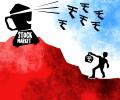
The rally in mid- and small-cap stocks has spilled over into the IT sector as well. Second and third-tier IT stocks, which historically traded at a discount to the big five IT companies, are now trading at nearly 25 per cent premium to their large-cap peers. The smaller IT companies have a price-to-earnings (P/E) multiple of nearly 38 times against the big five's current P/E multiple of around 31x.

Mobile operators with the exception of Reliance Jio are in a much worse financial condition than expected earlier. The combined borrowing of the four incumbent operators - Bharti Airtel, Vodafone Idea, Bharat Sanchar Nigam (BSNL), and Mahanagar Telephone Nigam (MTNL) - reached an all-time high of Rs 3.85 trillion at the end of March this year. The companies' combined debt was up 22.4 per cent year-on-year last financial year against 8.3 per cent growth in their borrowing in the previous year. As a result, the incumbent operators' debt-equity ratio shot up to an unsustainably high level of 6.83X at the end of March this year from 2.3X at the end of March 2020. This was largely due to big losses reported by all these companies last financial year. The four incumbent operators racked up combined net losses of Rs 70,000 crore in FY21.

Tata Motors has halved the volume outlook for its UK subsidiary Jaguar Land Rover Automotive (JLR) and warned of lower earnings as it sees the semiconductor shortage deepening in the September quarter of the current financial year, according to a notification issued by the company to the stock exchanges on Tuesday. The announcement caught investors unawares. They were hoping for a quicker recovery. Tata Motors' stock tanked 13 per cent (on July 6) from the day's high of Rs 358.10 and hit the lower circuit (Rs 311.45) in intra-day trades.

Since home-delivered meals from five-stars are cheaper by 15 to 20 per cent as compared to eating at the destination outside, food delivery has emerged as an important part of every restaurant's service portfolio.

Close to half a dozen more three-row premium mid-size models are expected to hit the road over the next two years.

'While most companies were bullish before the second wave of double-digit sales growth in FY22, that may not be the case now.'

'I have personally been very keen on investing in lithium ion battery technology for some time.'

The 14 listed Tata group companies in which Tata Sons holds a stake are paying out a record Rs 35,441 crore to their shareholders by way of dividends and share buyback for FY21.

Auto sales, particularly of two-wheelers, may not bounce back immediately and may take another two months to come back on track even as car bookings have started seeing an initial uptick. Various states started Unlock 2.0 on Monday, following a fall in the number of Covid-19 cases. Auto sales were hit in May following the impact of Covid-led lockdowns.

Smaller stocks continue to shine at the bourses. The BSE MidCap index is up 18 per cent since the beginning of January this year against a 5 per cent rise in the Sensex during the period. With the current rally, the mid-cap index has doubled in value since the end of March 2020 against a 70 per cent rally in the Sensex during the period. On Tuesday, the mid-cap index closed at 21,232, as compared to 17,941 at the end of December 2020. In the same period, the benchmark index moved from 47,751 to 50,193.

India's top IT companies have shown a hiatus between their performance on the bourses in the pandemic period and earnings growth. The combined market cap of the top five IT companies - Tata Consultancy Services, Infosys, Wipro, HCL Technologies, and Tech Mahindra - is up 87 per cent since the end of March 2020. In comparison, the benchmark BSE Sensex is up 68 per cent during the period. So the industry beat the broader market by a big margin in the last one year.
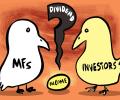
The combined dividend payout by early-bird companies -- those that have declared their results for FY21 -- is up 8.9 per cent, lower than the 21.9 per cent rise in in FY20 but ahead of the underlying growth in India Inc business last year. Combined net sales of these early birds were down 1.8 per cent last financial year while net profit was up 27.3 per cent in FY21. Some top companies that have stepped up dividend payout in FY21 include Hindustan Unilever, Indus Towers, Tata Steel, Ultratech Cement, Larsen & Toubro, Dabur, Asian Paints, and UPL. In contrast, banks have skipped dividends under an RBI diktat while companies such as Marico, TCS, Maruti Suzuki, and Godrej Consumer are paying lower dividends for FY21.

Thanks to a continued rise in the market capitalisation of the Adani Group companies, its promoter Gautam Adani is now the second richest Asian and fourteenth richest businessman in the world with a networth of $66.5 billion. Reliance Industries promoter Mukesh Ambani remains the wealthiest businessman in Asia with a networth of around $76.5 billion, according to Bloomberg data. The six Adani Group companies had combined market capitalisation of Rs 8.36 trillion as on Thursday, against Reliance Industries' market capitalisation of Rs 12.6 trillion. Adani Green tops the charts in the group with m-cap with Rs 1.99 trillion.

In 2020, after the outbreak of the Covid-19 pandemic, several five-star hotel chains commenced home delivery of food as a lot of people preferred to stay indoors. A year later, as the Covid situation worsens, such hotels are going the extra mile to cater for the gastronomical needs of their customers. With health, nutrition, and immunity occupying the mind spaces, these hotels are crafting menus that are not only high on health quotient, but also have food capable of improving the mood. The move, they hope, would help them get more customers as prices are also competitive.
 © 2026 Rediff.com - Advertise with us - Disclaimer - Privacy Policy - Sitemap - Feedback - About us - Terms of use - Grievances